Can a Faulty Tensioner Pulley Lead to Serious Engine Damage?
It can be affirmed that a defective or faulty tensioner wheel may not only lead to costly repairs, but also trigger a serious engine disaster. The tensioner pulley, as the core regulator of the timing system, is mainly responsible for maintaining the precise tension of the belt or chain. When the tensioner pulley bearing begins to fail (the typical symptom is that the abnormal noise level may exceed 85 decibels), or its surface coating is excessively worn (the roughness Ra value exceeds 12.5 microns), it will cause the belt's runout frequency to increase by more than 50% of the normal value or become completely loose. At this point, the efficiency of belt drive will drop sharply from the optimal 98% to below 60%. The most direct consequence is the collapse of the accessory system - the water pump stops circulating the coolant. 80% of the engines will deform the cylinder head within 5 to 10 minutes due to overheating exceeding 130℃ (deformation exceeding 0.3mm is beyond the repair limit). For instance, in 2018, a large North American fleet suffered from the failure of the wholesale tensioner wheel bearing seal. This led to the simultaneous scrapping of 23 engines due to overheating.
A more disastrous chain reaction occurs in the failure of the timing system at the core of the internal combustion engine. Once the tensioner pulley loses its tension control ability, the timing belt or chain has a very high probability (industry statistics show that the probability exceeds 65% when the tension is suddenly out of control) of tooth skipping. The synchronization accuracy requirements of the timing system are extremely strict. Generally, the synchronization error of the camshaft and crankshaft positions must be controlled within ±1.5 degrees. A single tooth skipping event can cause a phase misalignment of more than 15 degrees. This will directly cause the moving piston to forcefully strike the open valve at a maximum linear velocity of 20 meters per second. According to SAE research data, the impact force generated by such impacts at a rotational speed of 4000rpm can exceed 2 tons, causing the valve stem to bend (replacement is required when the bending amount is greater than 0.1mm) or break (failure occurs when the material shear stress exceeds 800MPa), and the top of the piston to collapse (collapse depth exceeds 1mm). In more serious cases, such as piston breakage, the fragments may penetrate the side walls of the cylinder block (the tensile strength limit of cast iron cylinder blocks is approximately 250MPa), resulting in irreparable complete damage to the engine, with direct economic losses averaging over 30,000 RMB. In recent years, many global recall incidents of various brands (such as a certain brand recalling 100,000 vehicles in 2019 due to design flaws in tensioner wheels) have all originated from the potential risk of interference and collision caused by such design or manufacturing defects.
Even a seemingly gentle swing of the belt can cause hidden damage. The vibration amplitude of the belt caused by the failure of the tensioner pulley will increase sharply to more than three times the normal amplitude (usually exceeding a peak-to-peak value of 5mm). Abnormal high-frequency vibration transmission not only damages nearby components (such as shortening the service life of water pump bearings by 90%, usually failing within 5,000 kilometers), but more seriously, belt debris (with a wear rate exceeding 2 grams per 100 kilometers) can contaminate the oil circuit. Once the oil pump filter screen is clogged by debris larger than 70 microns over 30% of its area, the oil pressure will instantly drop from the normal value (250-500kPa) to the dangerous value (below 100kPa). At this point, the high-speed friction pairs inside the engine, such as the crankshaft, camshaft, and turbocharger, will form dry friction due to lack of oil within seconds. Tragedies like the melting of bearing shells (the melting point of the copper-lead alloy layer is approximately 300℃) and the scratching of the journal (scratches deeper than 0.02mm require replacement) are almost inevitable, and the overall maintenance cost also exceeds 20,000 yuan.
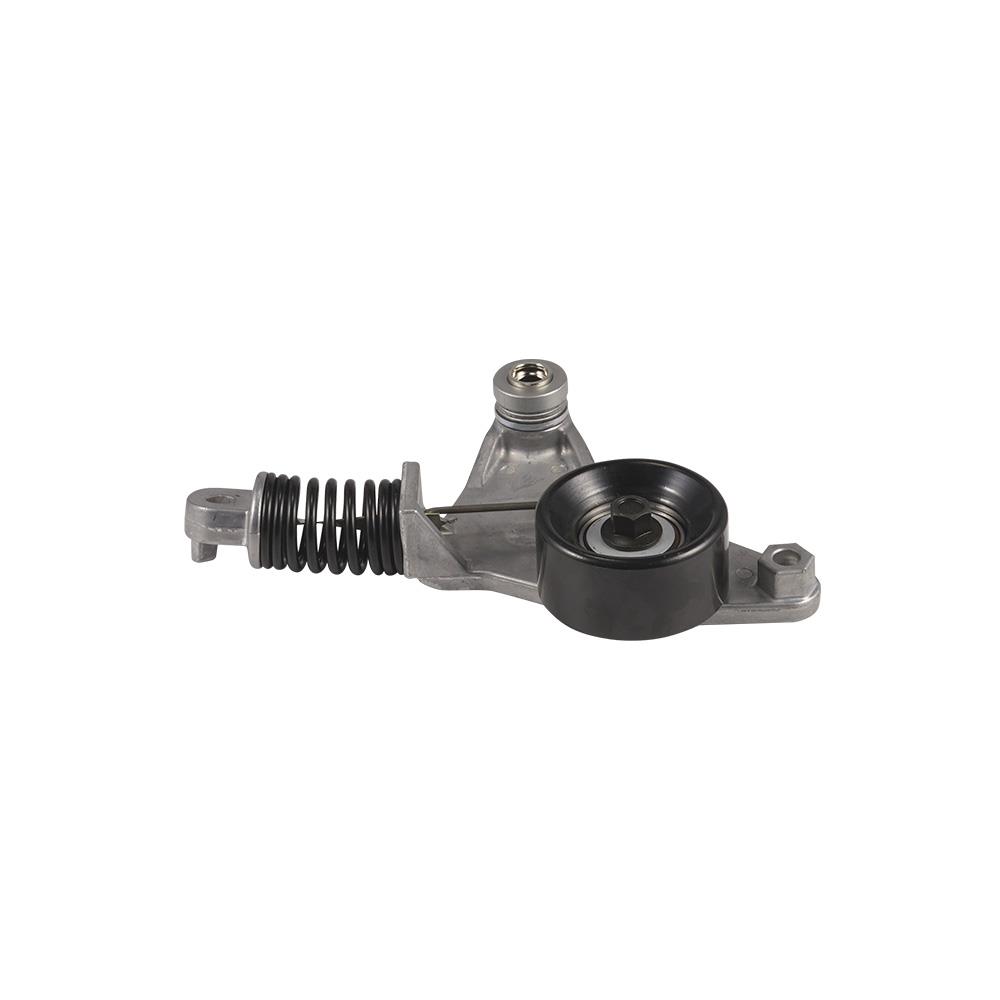 Economic losses and security risks are a double blow. Delaying the replacement of the problem Tensioner Pulley in an attempt to save around 300 yuan in component costs may result in economic losses dozens of times higher. A report from an independent research institution in 2019 pointed out that in cases of severe engine damage, nearly 15% of the root causes could be traced back to the initial faults related to the tensioner wheel. What cannot be ignored even more is the risk of sudden failure caused by component failure. When the timing system crashes during high-speed driving, it will trigger the ECU to forcibly cut off the fuel and shut down the engine, instantly causing the power steering to fail (the static friction resistance of the steering system may be as high as 300Nm), and the brake assistance to decline (the vacuum assistance value drops to less than 30% of the normal value). According to statistics from the European Union's Transport Safety Committee, This would prolong the driver's reaction time by more than 1.3 seconds and increase the accident risk by 400% in the highway scenario. This kind of secondary accident caused by vehicle powerloss is a major focus of insurance claims (especially when it involves casualties), and the liability for compensation goes far beyond the engine repair itself.
Preventive maintenance of the timing system (actively replacing the timing kit with tensioning wheels every 60,000 to 80,000 kilometers) can nip faults in the bud. High-quality after-sales tensioning wheel components (such as Gates or INA products, bearings are usually designed with high-strength alloy steel and long-lasting grease, with an expected service life of over 150,000 kilometers), in combination with standardized installation (torque tightening accuracy requirement ±2Nm, idler wheel arm swing Angle controlled within ±5°), can provide a safety guarantee that is a hundred times the cost. Every time you hear an abnormal noise from the tensioner wheel, stop the vehicle immediately (to avoid a chain reaction due to overheating), or replace it in advance according to the maintenance manual. This is the most economical and effective protection strategy for expensive engines (where the power unit accounts for 15% to 25% of the vehicle's total cost).
Economic losses and security risks are a double blow. Delaying the replacement of the problem Tensioner Pulley in an attempt to save around 300 yuan in component costs may result in economic losses dozens of times higher. A report from an independent research institution in 2019 pointed out that in cases of severe engine damage, nearly 15% of the root causes could be traced back to the initial faults related to the tensioner wheel. What cannot be ignored even more is the risk of sudden failure caused by component failure. When the timing system crashes during high-speed driving, it will trigger the ECU to forcibly cut off the fuel and shut down the engine, instantly causing the power steering to fail (the static friction resistance of the steering system may be as high as 300Nm), and the brake assistance to decline (the vacuum assistance value drops to less than 30% of the normal value). According to statistics from the European Union's Transport Safety Committee, This would prolong the driver's reaction time by more than 1.3 seconds and increase the accident risk by 400% in the highway scenario. This kind of secondary accident caused by vehicle powerloss is a major focus of insurance claims (especially when it involves casualties), and the liability for compensation goes far beyond the engine repair itself.
Preventive maintenance of the timing system (actively replacing the timing kit with tensioning wheels every 60,000 to 80,000 kilometers) can nip faults in the bud. High-quality after-sales tensioning wheel components (such as Gates or INA products, bearings are usually designed with high-strength alloy steel and long-lasting grease, with an expected service life of over 150,000 kilometers), in combination with standardized installation (torque tightening accuracy requirement ±2Nm, idler wheel arm swing Angle controlled within ±5°), can provide a safety guarantee that is a hundred times the cost. Every time you hear an abnormal noise from the tensioner wheel, stop the vehicle immediately (to avoid a chain reaction due to overheating), or replace it in advance according to the maintenance manual. This is the most economical and effective protection strategy for expensive engines (where the power unit accounts for 15% to 25% of the vehicle's total cost).
Economic losses and security risks are a double blow. Delaying the replacement of the problem Tensioner Pulley in an attempt to save around 300 yuan in component costs may result in economic losses dozens of times higher. A report from an independent research institution in 2019 pointed out that in cases of severe engine damage, nearly 15% of the root causes could be traced back to the initial faults related to the tensioner wheel. What cannot be ignored even more is the risk of sudden failure caused by component failure. When the timing system crashes during high-speed driving, it will trigger the ECU to forcibly cut off the fuel and shut down the engine, instantly causing the power steering to fail (the static friction resistance of the steering system may be as high as 300Nm), and the brake assistance to decline (the vacuum assistance value drops to less than 30% of the normal value). According to statistics from the European Union's Transport Safety Committee, This would prolong the driver's reaction time by more than 1.3 seconds and increase the accident risk by 400% in the highway scenario. This kind of secondary accident caused by vehicle powerloss is a major focus of insurance claims (especially when it involves casualties), and the liability for compensation goes far beyond the engine repair itself.
Preventive maintenance of the timing system (actively replacing the timing kit with tensioning wheels every 60,000 to 80,000 kilometers) can nip faults in the bud. High-quality after-sales tensioning wheel components (such as Gates or INA products, bearings are usually designed with high-strength alloy steel and long-lasting grease, with an expected service life of over 150,000 kilometers), in combination with standardized installation (torque tightening accuracy requirement ±2Nm, idler wheel arm swing Angle controlled within ±5°), can provide a safety guarantee that is a hundred times the cost. Every time you hear an abnormal noise from the tensioner wheel, stop the vehicle immediately (to avoid a chain reaction due to overheating), or replace it in advance according to the maintenance manual. This is the most economical and effective protection strategy for expensive engines (where the power unit accounts for 15% to 25% of the vehicle's total cost).